Diamond Grinding vs. Acid Etch: Why Prep Decides Whether a Coating Lasts
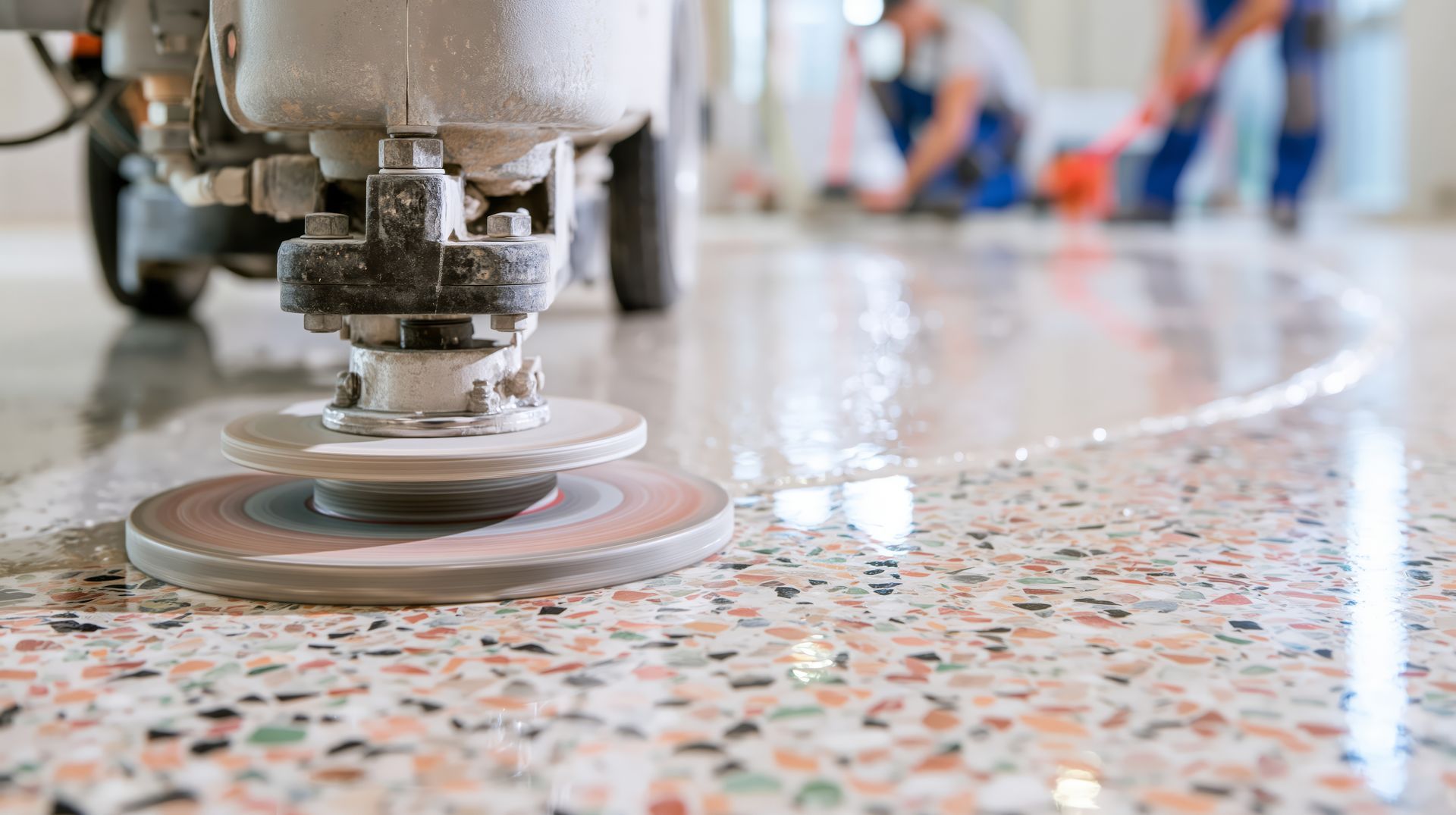
Two floors can get the same coating, from the same bucket, applied by people with the same training, and one of them peels in the second winter while the other looks new. The difference is almost always underneath. Surface preparation is the single largest predictor of adhesion failure, and there are only two realistic ways to prepare a residential slab: mechanical diamond grinding or chemical acid etching. They are not equivalent.
This is the plain explanation of why, from the crew at Keas Concrete Coatings.
If you are still deciding between coating chemistries, start with our overview of polyurea and polyaspartic systems. This post assumes you have picked a system and want to know what has to happen to the concrete before it goes down.
What a coating actually bonds to
A finished concrete slab is not the material most people picture. Troweling pushes fine cement paste and water to the top, leaving a dense, closed skin that can be weak, chalky and slick. Curing compounds, sealers and years of tire traffic sit on top of that. A coating applied to this skin is bonded to the skin, not to the concrete, and the skin is the part that lets go.
Preparation has two jobs: remove everything that is not sound concrete, and open the surface so the coating has mechanical grip and somewhere to flow into. Removing contaminants is the easy half. Opening the surface is where grinding and etching part ways.
The CSP scale, and why it makes this argument concrete
The International Concrete Repair Institute publishes a set of Concrete Surface Profile chips, CSP 1 through CSP 9, that give contractors a shared physical reference for how rough a prepared surface is. CSP 1 is the smoothest, produced by acid etching. CSP 2 corresponds to grinding. CSP 3 is light shotblasting. The scale continues upward through scarification and heavy abrasive blasting for repair mortars and overlays that need far more tooth.
Thin film coatings generally target the low end of that range, and the coating manufacturer specifies which profile their product requires. This is the part that matters: the profile is a specification, not a preference. When a data sheet calls for a specific CSP, a floor prepared below it is out of spec whether or not the coating looks fine on the day of the install.
The CSP chips exist because words like clean, rough and prepped mean different things to different crews. A number does not.
What diamond grinding does
Grinding uses diamond segments on a rotating head to cut the surface off. It is a subtractive mechanical process, so what it removes is gone, and what it leaves behind is fresh concrete with an even, measurable texture.
Three things make it the professional default. It is consistent, because the profile depends on tooling and technique rather than on how a chemical happened to react across a floor with uneven density. It removes existing coatings, sealers and curing compounds along with the weak surface layer. And it produces a dry, vacuum collected dust rather than a liquid that has to be neutralized and rinsed away.
Grinding is also diagnostic. Once the surface opens up, cracks, spalls, previous patch work and soft areas become visible, which is when they should be repaired. That sequencing matters and is covered in our guide to substrate repair before coating. Repairs happen after profiling and before the base coat, never after.
The downside is cost. Grinding requires equipment, tooling that wears out, dust collection and a trained operator. That is precisely why the retail kit sitting on a shelf does not include it.
What acid etching does
Etching uses an acid solution, traditionally muriatic acid or a safer proprietary blend, to dissolve a small amount of cement paste at the surface. It is chemical rather than mechanical, and it is the method nearly every consumer kit specifies, because a jug of acid ships in a box and a grinder does not.
The problems are practical. Etching reacts with the material it contacts, so it works unevenly across a slab whose density and porosity vary, which every real slab does. It does almost nothing to oil-contaminated areas, since the acid cannot reach the concrete through the oil.
It will not remove an existing sealer or coating, so a floor that was ever sealed cannot be properly etched at all. It leaves salts and reaction residue behind that must be fully rinsed and neutralized, and any residue left in place becomes a bond breaker. And the resulting profile sits at the shallow end of the CSP range even when the process goes perfectly.
Etching is not useless. It has a place on specific bare, uncontaminated slabs with thin materials that call for that profile. It is simply not a substitute for grinding under a durable garage floor system.
Why the shortcut shows up two winters later, not two weeks later
A coating over a poorly prepared floor usually looks perfect at handover. Gloss, color and flake coverage have nothing to do with adhesion. The bond is the one property you cannot see.
Then Colorado gets to work on it. Moisture migrates through the slab and collects at any weak interface. Temperatures swing thirty degrees in an afternoon, and the coating and the concrete expand and contract at different rates. Hot tires park on it, deicing salts come in on the vehicle, and every one of those stresses pulls at the bond line. A properly profiled floor distributes that stress into sound concrete. A weakly profiled floor concentrates it at the skin, and the skin fails, usually taking a sheet of coating with it.
That is why failures cluster in spring, after the first or second freeze-thaw season. The symptoms, and what they look like on a Colorado floor, are catalogued in our post on why garage floor coatings fail after winter. This post covers the cause; that one covers the evidence.
What this means if you are getting quotes
Prep is the easiest line item to cut and the hardest one for a homeowner to inspect, which is exactly why it gets cut. A few questions separate the quotes quickly.
Ask what method will be used to prepare the slab, and expect a specific answer. Ask what surface profile the coating manufacturer requires for the system being installed. Ask how existing sealer, oil staining and the garage door pan will be handled, since those are the three places shortcuts hide. Ask whether crack and spall repair is included in the price or billed as a change order once the floor is open.
A contractor who grinds will be glad to talk about it, because it is the expensive part of the job and the reason their number is higher than the kit at the hardware store. If prep is vague in the proposal, it is vague on the floor. Our guide to comparing concrete coating quotes covers the rest of the paperwork.
Frequently asked questions about concrete surface preparation
Why do garage floor coatings peel?
Most peeling traces back to a bond that was never fully established: an unremoved sealer, oil left in the slab, etching residue, or a surface profile below what the coating required. Moisture moving up through the slab is the other major cause. Both are prep and diagnosis problems rather than product problems.
Can I etch instead of grinding to save money?
You can, and it is what most do it yourself kits instruct. It also removes the main advantage a professional install has over the kit. If the floor has ever been sealed or has oil staining, etching will not get you a bondable surface at any price. The common failure points of that approach are covered in our post on do it yourself garage coating mistakes.
Does grinding damage the concrete?
No. Grinding removes a thin layer of the weak surface skin and leaves sound concrete with a measurable texture. It does not affect the structural slab. Homeowners often find the ground floor looks worse before the coating goes on, which is expected: you are seeing the actual concrete for the first time.
How much concrete gets removed?
A very small amount, enough to take off the troweled skin and any coating or sealer above it. Heavily contaminated or previously coated floors need more passes and more tooling, which is why an estimator should look at the slab before quoting.
Have a floor you want prepared properly?
Every Keas install starts with mechanical grinding because it is the only prep method that produces a consistent, specified profile on a real Colorado garage floor. To get a written scope that says exactly how your slab will be prepared,
schedule a free on site estimate and we will assess the concrete before we price the coating.